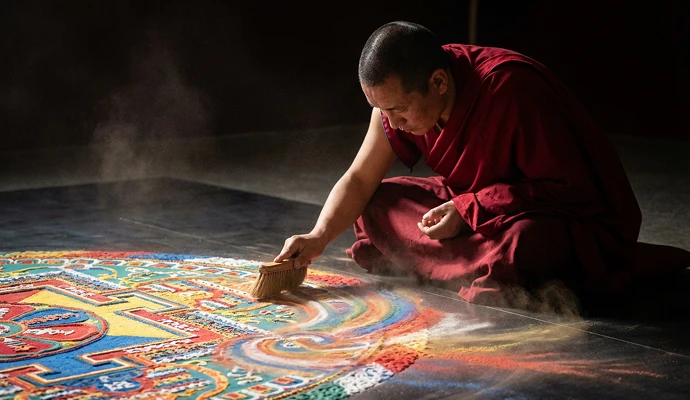
In the hustle and bustle of modern life, it is easy to feel disconnected and overwhelmed. However, an ancient art form—practiced for over two millennia—is now capturing the hearts of art collectors, meditation practitioners, and psychologists worldwide: The Mandala.
At Mandala Tashi, we believe a Mandala is more than just a beautiful visual; it is a sacred map of the cosmos and a bridge leading to inner tranquility. Let’s explore the deep wisdom behind these intricate circles.
What is a Mandala?
The word "Mandala" originates from ancient Sanskrit, meaning "circle" or "center." In Tibetan Buddhism, it is known as "Kyilkhor" (壇城), which translates to "the residence of deities" or "extracting the essence."
At its most basic level, a Mandala is a geometric design representing the universe. However, spiritually, it is a microcosm of the cosmos, symbolizing the perfect order of the universe and the wholeness of life.
The Symbolism: A Journey from the Outside In
Every detail in a Mandala carries a profound spiritual meaning. The structure typically follows a specific symbolic logic:
- The Outer Circle: Represents the infinite nature of the universe and a protective divine boundary.
- The Inner Square: Represents the earthly realm and the four cardinal directions (North, South, East, West), often depicted with "gates" leading into the sacred space.
- The Center Point (Bindu): The starting point and the final destination. It represents the source of all existence and the attainment of enlightenment or the "True Self."
- Colors and Motifs: Various colors (Blue, Red, Yellow, White, Green) and symbols (like the Lotus or Vajra) embody different energies such as compassion, wisdom, and spiritual power.
Why are Mandalas Essential in Modern Life?
Mandalas are not just relics found in museums; they are vibrant tools for personal transformation in the 21st century:
1. Enhancing Meditation and Focus
Mandalas are widely used as a Drishti (focal point) during meditation. By centering your gaze on the Mandala, the mind begins to settle, distractions fade, and you enter a state of deep concentration. This "outer-to-inner" visual guidance is highly effective for reducing stress and anxiety.
2. Psychological Healing and Balance
The famous psychiatrist Carl Jung introduced the Mandala to Western psychology. He viewed the creation and contemplation of Mandalas as a form of "self-healing," reflecting the subconscious state and helping individuals integrate their fragmented emotions into a unified whole.
3. Transforming the Energy of Your Space
Placing a high-quality, authentic Mandala in your home or office does more than enhance the aesthetic. Its symmetrical and harmonious structure creates a sense of peace and "Tashi" (auspiciousness), purifying the energy of the room.
Discover Your "Destiny Mandala" at Mandala Tashi
Every Mandala carries a unique vibration. Whether you are looking for a traditionally hand-painted Thangka Mandala or a contemporary piece of spiritual art to grace your walls, Mandala Tashi is dedicated to providing authentic works of the highest spiritual and craftsmanship value.
Final Thought:
A Mandala is a journey. It begins at the edges and leads us to our center. In a world of chaos, owning a Mandala is like having a compass that always points back to your inner peace.
_______________________________________________________________________________________
[Browse Our Exclusive Mandala Collection & Find Your Center Today]
https://www.mandalatashi.com/en/list/mandala-energy_6?page=3